
There are many types of filling, each suitable for different cavities. Your dentist will discuss the most suitable filling for your mouth.
If a cavity is left untreated, the infection will eventually reach the nerve and blood vessels of the tooth. A filling stops this process and so stops you losing the tooth.
What happens
Most people have a local anaesthetic injection to completely numb the tooth; the numbness can take a few hours to wear off. The decayed and weakened parts of the tooth are removed with small drills, medicament is placed where needed, and the tooth is filled.
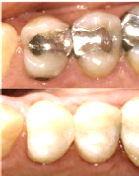
Amalgam fillings (not tooth coloured)
Amalgam is made from a combination of metals including silver, tin, copper and mercury. It is extremely durable and withstands the grinding and chewing of back teeth over long periods. It does not glue the tooth together; it is held in place by cutting a retentive shape into the tooth.
Tooth-coloured fillings
Tooth-coloured fillings match the colour of your teeth, making them a natural-looking alternative to amalgam, and are often used in teeth that show when you smile or talk. They are not as durable as amalgam, so are not always suitable for the chewing surfaces of back teeth.
They must be kept completely dry while they set, so the dentist may place a sheet of rubber over your tooth (a rubber dam) or use cotton wool rolls.
Adapted from the British Society for Restorative Dentistry.
Having a filling is the process of removing the bacteria and damaged tooth structure and reconstructing the tooth. It is a mini exercise in engineering. We provide the latest materials and techniques as a cost-effective alternative to NHS dentistry.