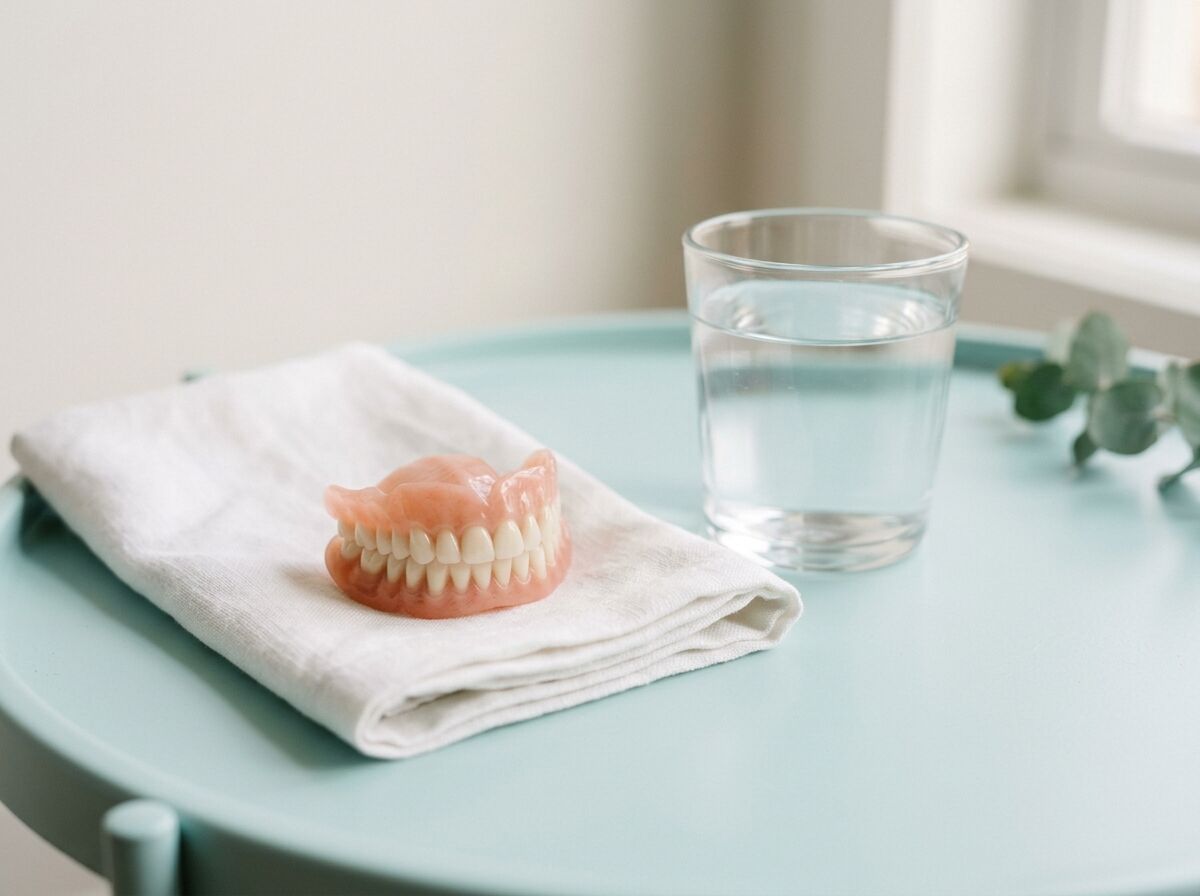
- Complete dentures replace all of the teeth.
- Partial dentures replace only the missing teeth.
- Immediate dentures are fitted as soon as teeth are removed.
- Implant-retained dentures clip onto dental implants, full or partial.
Complete dentures
Suitable for patients whose teeth are failing, most commonly from gum disease or decay. They are held in place by suction to the gums and denture fixative. A set usually needs replacing after about ten years. We can replace loose dentures using the latest techniques; the process takes approximately eight weeks.
Immediate dentures
The move from teeth to a denture can be challenging, and some mouths adapt better than others. Usually it involves around four appointments to take impressions and make the denture, which is then fitted at the time the teeth are removed. Removing all the teeth is called a dental clearance; over the following six weeks the bone and gums start to reshape.
The area will be tender for a few weeks, and you should expect a period where speaking and eating are difficult. In the six months after extraction the jaw can change shape and the denture may become loose; a reline can improve the fit. If you are anxious about having teeth removed, see our page on sedation.
Immediate dentures are a temporary solution, made from the most economical materials, so they have a shorter lifespan and are guaranteed for six months from fitting. Once the gums have settled, a definitive denture with better quality teeth and a metal or plastic framework is made.
Partial dentures
Acrylic partial dentures
Most suitable for patients who are losing teeth over the years, as further teeth can be added. We use a higher quality denture plastic and denture teeth than generally used for NHS dentures. Making one takes four to six appointments, about a week apart.
Chrome cobalt dentures
A metal framework gives a thin, strong, less intrusive denture that is generally considered less damaging to the gums. The framework has clasps that connect to the teeth.
Implant-retained partial dentures
Where few teeth are available to support a denture, or the shape of the mouth lets it loosen easily, dental implants can hold it securely. The denture has a clip that attaches to the implant.
For more information see the British Society of Prosthodontics.
There is no denying that dentures give a perfect smile. Combined with dental implants to aid retaining the denture in the mouth, they provide a stunning solution to replacing missing teeth, giving patients confidence with smiling, eating in public and talking.